
ICAO Level 4 does not have a worldwide expiry date that you can apply without checking your licence type and the relevant rules. ICAO recommends a three-year re-evaluation interval. EU Part-FCL pilot rules specify four years, while EU controller rules and the published Thai controller rules reviewed here specify three.[1][2][3][4]
The “three years” and “four years” answers you find online are therefore not necessarily contradictory. The question is whether a particular rule applies to your licence and language proficiency endorsement.
This article explains the difference and how to check your own expiry date. It does not replace your licensing authority's decision about an individual licence or provide a complete account of every country's rules.
A test result and a licence endorsement are not the same thing
People discussing the validity of an “ICAO English certificate” may mean a report issued by a testing organisation or the language proficiency endorsement on a licence. These records are related, but they are not interchangeable.
A test report may show that you achieved Level 4 in a particular assessment. Whether an authority accepts that report, how an endorsement is issued and when re-evaluation is required depend on the applicable procedures. Do not assume that a rating on a report, by itself, grants or extends licence privileges.
Check your language endorsement, any language proficiency certificate recognised by your authority and the corresponding rules. If the records disagree, ask your licensing authority rather than choose the longest period you have seen online.
This is ATCBase's explanation of how to approach the documents, not a country-specific endorsement application procedure.
Where do the three-year and four-year periods come from?
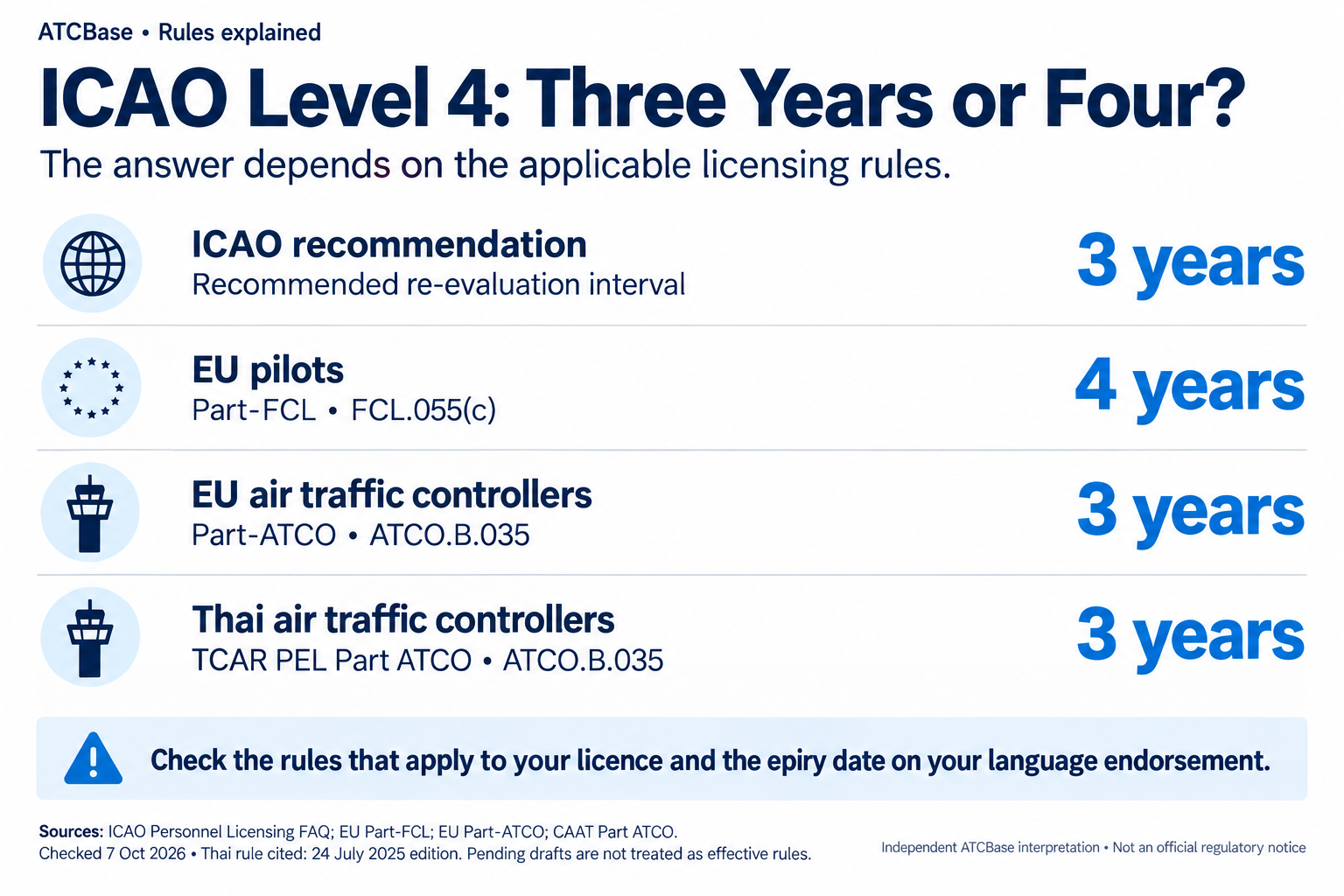
The graphic compares different regulatory contexts, not a universal validity period for test reports. Sources and editions are listed below.
- ICAO recommendation: Level 4 re-evaluation at three-year intervals and Level 5 at six-year intervals. Level 6 is outside the FAQ's stated requirement for periodic formal re-evaluation of people below the expert level.[1]
- EU Part-FCL pilots — FCL.055(c): re-evaluation every four years at Level 4 and every six years at Level 5. Level 6 pilots are excluded from the periodic re-evaluation intervals in that paragraph.[2]
- EU air traffic controllers — ATCO.B.035: English endorsement validity is three years at Level 4, six at Level 5 and nine at Level 6.[3]
- Thai air traffic controllers — published TCAR PEL Part ATCO, ATCO.B.035: three years at Level 4, six at Level 5 and unlimited at Level 6.[4]
These sources use concepts such as re-evaluation intervals and endorsement validity. They should not be reduced to one validity period for every examination report.
An ICAO recommendation can also be a binding local requirement
ICAO's Personnel Licensing FAQ describes the three-year and six-year intervals as recommendations. It also explains that people demonstrating proficiency below Level 6 undergo formal re-evaluation at intervals appropriate to their proficiency.[1]
That does not allow individuals to choose their own schedule. If the rules governing your licence prescribe three years, the fact that ICAO describes the interval as a recommendation is not a reason to postpone re-evaluation.
A pilot's four-year interval does not automatically apply to a controller
The EASA Aircrew compilation specifies four-year re-evaluation for Level 4 pilots in FCL.055(c).[2] EU controllers are governed by a different regulation, with a three-year Level 4 English endorsement.[3]
If you are a controller reading that “EASA Level 4 lasts four years”, check whether the source is discussing pilots. The same language rating does not imply the same licensing requirements.
Is ICAO Level 6 valid for life?
“Level 6 is valid for life” is not a worldwide rule. EU controllers have a nine-year Level 6 English endorsement, while the published Thai Part ATCO version reviewed for this article specifies unlimited validity.[3][4]
For EU pilots, FCL.055(c) excludes Level 6 from the periodic re-evaluation intervals set out in that paragraph.[2] This does not make other ratings, medical certificates or licence privileges permanently valid.
Keep the scope of “unlimited” in view: it describes a language endorsement under particular rules, not an entire professional qualification or a claim that language skills never need maintaining.
What can controllers in Thailand and Malaysia check?
For Thailand, consult CAAT's TCAR PEL Part ATCO, Issue 01 Revision 00, dated 24 July 2025. ATCO.B.030 and ATCO.B.035 appear on printed page 16. The published document requires a valid English endorsement and specifies three years for Level 4, six for Level 5 and unlimited validity for Level 6.[4]
Update note: CAAT published a Part ATCO amendment consultation on 25 September 2026, with comments invited until 23 October. The page identifies it as a draft. This article does not treat the proposed amendment as an effective rule. Before applying, check formal announcements and any applicable transition arrangements.[6]
For Malaysia, consult CAD 1201 ATC Licensing, Issue 02 Revision 00, in CAAM's official directory. Section 5 of Appendix 5, within section 7.5, requires controllers at Level 4 to be evaluated at least once every three years and those at Level 5 at least once every six years. It explicitly directs controllers to the expiry date on the ELPT certificate issued by CAAM.[5]
We have not completed an equivalent review for Indonesia, Vietnam or every other country. These periods should not be extrapolated to those jurisdictions.
When does the validity period start?
Do not always calculate “assessment date plus three years”, or assume that testing earlier necessarily extends your next expiry date. Initial issue, revalidation before expiry and renewal after expiry can involve different calculations.
For example, EU ATCO.B.035(c) provides that, when a successful assessment for revalidation takes place within the three months immediately before expiry, the new validity period is counted from the existing expiry date. An earlier assessment is subject to a different starting-date provision.[3]
This illustrates why the specific clause matters. It does not mean that all readers can use the EU three-month arrangement.
Ask the authority or organisation handling your endorsement a complete question: “This is my licence type and current endorsement expiry date. If I complete re-evaluation on this date, when will the new endorsement start and expire, and which clause applies?” That is more useful than asking only how many years ICAO Level 4 lasts.
What should you confirm before expiry?
The following is ATCBase's administrative preparation guidance, not a universal statutory timetable.
- Identify the correct record: check the language, level, expiry date, licence type and issuing authority. Do not confuse the date with a medical certificate or unit endorsement expiry.
- Confirm acceptance: ask which assessments or testing organisations the authority accepts for this revalidation.
- Check processing time: distinguish appointment availability, result reporting and endorsement processing. Passing a test does not necessarily mean the endorsement process is complete.
- Confirm the calculation: before booking, ask whether an early assessment changes the next expiry date and keep the authority's written explanation.
If your endorsement has already expired, do not assume a grace period exists. Confirm the assessment and administrative steps required for renewal, and whether you may exercise the relevant privileges while waiting. The published Thai rules require controllers and student controllers to hold a valid English endorsement to exercise the relevant licence privileges.[4]
Does changing test provider or country give you longer validity?
A provider advertising “Level 4 — four years” does not, by itself, extend a three-year endorsement. The question still depends on the applicable licensing rules, acceptance of the result and endorsement procedures.
When using a result abroad, converting a licence or changing authorities, ask two separate questions: will the authority accept this assessment, and, if it does, what validity period and procedure will apply? Recognition of a result and its validity are not the same question.
This article does not promise worldwide acceptance or determine whether a particular report is suitable for an individual application.
How should you determine your own deadline?
Identify your licence and authority, find the applicable clause, then check the actual endorsement or recognised certificate expiry date. That is the basis for planning re-evaluation.
The useful explanation for three years versus four is that the sources may describe different systems and different licence holders. Understanding that distinction helps you avoid planning a controller's re-evaluation around pilot guidance, or treating one country's rules as a worldwide standard.
Sources and editorial method
This is an independent ATCBase interpretation prepared with AI-assisted research and drafting. The key periods and their scope were checked against the official provisions listed below. The article has not yet been reviewed by a named licensed expert and does not claim endorsement by ICAO, EASA, CAAT or CAAM. The document-checking steps and suggested questions are editorial guidance.
Sources were checked on 7 October 2026. The ICAO FAQ records a last update of 4 April 2018; it is used to explain ICAO recommendations, not as a substitute for subsequent local rules. The EU pilot section cites FCL.055(c) in EASA's November 2025 compilation; we do not claim to have checked every subsequent amendment. Before an actual application, verify the current formal rules and their applicability to your circumstances.
If you identify an amendment or an error, use the website's feedback feature and provide the authority's link, document edition and clause number so we can check and correct it. Adding a review date does not make an older, unchecked source current.
- [1] ICAO Personnel Licensing FAQ, question on re-evaluation intervals. Page last updated 4 April 2018.
- [2] EASA Easy Access Rules for Aircrew, November 2025 edition, printed page 101, FCL.055(c). See the publication and edition information.
- [3] Regulation (EU) 2015/340 consolidated text, version of 13 May 2026, Annex I, ATCO.B.035. Consolidated texts are documentation tools; the authentic legal acts can be accessed through EUR-Lex.
- [4] CAAT TCAR PEL Part ATCO, Issue 01 Revision 00, 24 July 2025, printed page 16, ATCO.B.030 and ATCO.B.035.
- [5] CAAM CAD 1201 ATC Licensing, Issue 02 Revision 00, Appendix 5 within section 7.5, section 5, ELPT Rating Validity, printed page 7-17. Verify editions through the official CAAM directory.
- [6] CAAT Part ATCO amendment consultation, published 25 September 2026. A draft consultation, not cited as an effective rule.