
You may already have an IELTS result and want to know whether you are close to ICAO Level 4. Or perhaps you know the IELTS scale and simply want a familiar reference for how demanding aviation English is.
There is no single IELTS score we can give as an accurate equivalent for every candidate. The official sources reviewed for this article do not provide a universal rule for converting an individual's IELTS result into an ICAO rating. Historical test materials have compared the two, but a broad comparison of abilities serves a different purpose from awarding a formal rating.
For a practical sense of the standard, think of Level 4 as the ability to communicate effectively about common, concrete, work-related matters and keep communication going when something unexpected happens or a misunderstanding needs clarification. Some accent and language errors are compatible with Level 4; sounding like a native speaker is not the requirement.[2]
Your IELTS Listening and Speaking scores can provide useful background. What still needs to be established is how you use those abilities in aviation-related communication.
Why do IELTS and ICAO comparison charts exist?
Not every comparison chart is invented. A 2013 EALTS information pack hosted by the British Council in Colombia includes a chart comparing IELTS, CEFR and ICAO ratings.[5] Its description refers to learners' listening and speaking abilities and the ICAO ratings they might be expected to achieve. It is a traceable historical reference, rather than a current worldwide policy for awarding ratings.
The crucial detail is what is being compared. An IELTS overall band score, a Listening score and a Speaking score are different measures. An expected level of performance also does not mean that a particular score automatically earns an aviation English rating. Reducing a chart to “ICAO 4 = IELTS X” loses those distinctions.
Using the Common European Framework of Reference for Languages, or CEFR, as an intermediate step does not resolve the problem. IELTS explicitly cautions that its relationship with the CEFR is not one-to-one and that comparisons should not be treated as precise equivalences between test results.[3] Converting IELTS to CEFR and then CEFR to ICAO still requires evidence for the second step.
Before relying on a chart, check who published it, when it was published, which abilities it compares and what it was intended to do. An admission requirement, a course-placement guideline and formal recognition of a test result can all use language scores for different purposes. We do not use the figures in the historical chart as current entry requirements or predictions of a pass.
What does Level 4 actually demand?
Looking at the communication involved is more helpful than assigning an IELTS number. The following situation is an ATCBase illustration, not an official sample question or a rated performance.
A trainee can introduce themselves fluently and express an opinion clearly on a general topic. That demonstrates useful ability in those tasks. In an aviation-related exchange, they may also need to explain what has happened, distinguish confirmed information from uncertainty and respond to follow-up questions.
For example, someone reports an unusual smell in the cabin, but its source has not been identified. Recognising a piece of aviation vocabulary is only part of understanding the message. The exchange also requires the participants to preserve that uncertainty, ask about missing information and avoid presenting an unconfirmed situation as a fact. This example concerns language and understanding, rather than operational decision-making.
Can the speaker continue when asked an unexpected question? Explain the same idea another way when a word is missing? Identify which part of a message needs clarification? Those behaviours help explain the demands of work-related communication more clearly than a rehearsed introduction does.
Level 4 does not require understanding everything on the first attempt, eliminating every grammatical error or removing a foreign accent. Its descriptors focus on effective communication and allow clarification strategies when complications arise.[2] Preparation should therefore address difficulties that affect meaning and interaction, rather than concentrate entirely on imitating a particular accent.
What can your IELTS result tell you?
Start with the individual scores. In IELTS Academic and General Training, the overall band is calculated from the average of Listening, Reading, Writing and Speaking, rounded according to IELTS rules.[1] A strong overall result can include a comparatively weaker Listening or Speaking score.
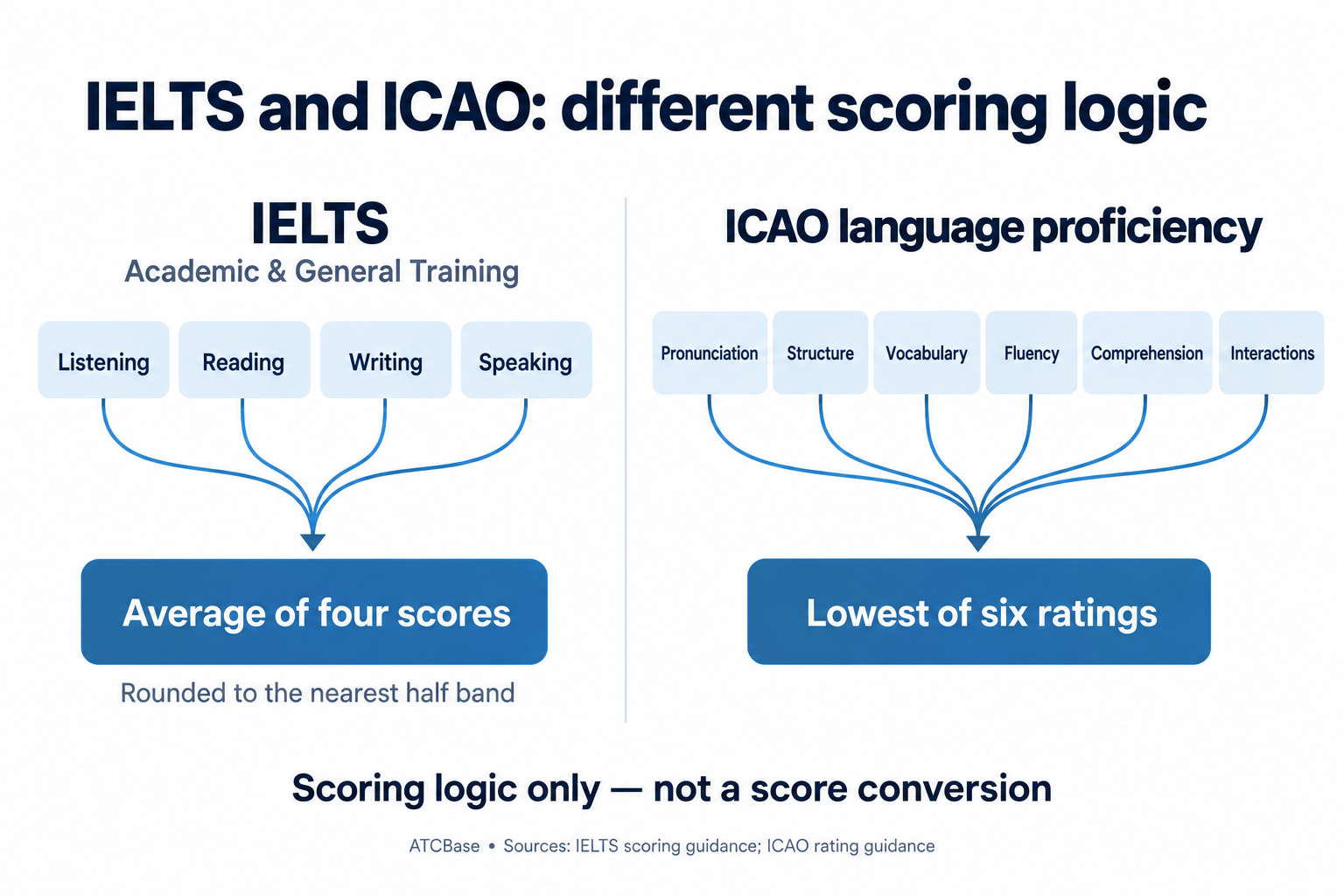
Scoring logic, not score equivalence. IELTS uses four component scores; ICAO uses six language proficiency ratings. Sources: IELTS scoring guidance and the FAA report applying the ICAO rating scale.
These fictional results illustrate why two people with the same overall band may have different preparation needs:
- Candidate A: Listening 7, Reading 8, Writing 7, Speaking 6. Overall: 7.
- Candidate B: Listening 7, Reading 7, Writing 7, Speaking 7. Overall: 7.
Candidate A's Speaking score is comparatively weaker and merits a closer look. Neither set of results, however, predicts an ICAO rating. Candidate B's more even profile still does not demonstrate performance in aviation-related communication.
The ICAO scale covers pronunciation, structure, vocabulary, fluency, comprehension and interactions. The overall rating is the lowest of the six.[2][4] Strong reading or writing skills cannot raise that rating by averaging out a weaker area.
If your question is “Is my IELTS 6.5 enough?”, the more useful details are your Listening and Speaking scores, where you struggle in actual exchanges, and whether those difficulties become more pronounced in aviation-related contexts. A 6.5 alone establishes neither that you are ready nor that Level 4 is out of reach.
Where should you focus your preparation?
The guidance below is ATCBase's interpretation for planning your preparation. It is not a way to award yourself a rating.
Listening and speaking are difficult even on familiar topics
If you regularly lose track of conversations or struggle to express basic ideas on familiar subjects, give attention to general listening and speaking while gradually introducing aviation-related topics. Learning more aviation terms alone is unlikely to resolve difficulties with understanding sentences, organising ideas or sustaining an exchange.
Try to identify the nature of the difficulty. Is a word unfamiliar, or do you recognise it but struggle to process the sentence in real time? Do you lack the words to express an idea, or find it difficult to put familiar words together? These distinctions are more useful for choosing what to work on than an overall score.
General conversation is comfortable but aviation topics are unfamiliar
You may already have a useful language foundation. The next question is whether you can describe work-related events, explain causes and uncertainty, and understand what another person means in that setting. Preparation can focus on applying your English to those demands, rather than automatically restarting with elementary general English.
Being familiar with standard phraseology is also only part of the picture. If you struggle once an exchange moves beyond familiar wording, spontaneous explanation and interaction deserve attention. Keep technical knowledge and language ability distinct: not knowing a particular procedure does not, by itself, establish a low language proficiency rating.
Work-related communication is familiar but the test is not
Read your chosen provider's candidate guidance, task descriptions and any published samples to understand how the test gathers evidence of your language ability. Do not assume that every test described as an “ICAO English test” uses the same format.
If your weaknesses are still unclear, diagnostic feedback organised around the six ICAO criteria may help. Look for feedback that identifies specific features of your performance and relates them to the descriptors, rather than simply saying you are “close to Level 4”. Diagnostic feedback can guide preparation; a formal rating must follow the applicable assessment process.
These three situations cannot be assigned to IELTS score bands. Nor can an overall IELTS result tell us how many weeks you need. That depends on your actual performance, the assessment you intend to take and the time available for learning.
Can an IELTS certificate replace an aviation English assessment?
An organisation's acceptance of IELTS for admission or recruitment does not automatically establish that it meets your licence's language proficiency requirements. Check the applicable requirements with the authority responsible for your licence or qualification and the relevant assessment provider.
A useful question is: “Does my IELTS result satisfy an admission or application requirement, or can it meet the language proficiency requirement for this licence? If it can, what policy applies, and is any additional assessment required?”
This concerns recognition of a certificate, which is separate from using a score as an indication of ability. If you have not taken IELTS, there is no reason to take it solely to obtain a conversion figure. First establish whether your target organisation actually requires it.
For Level 4 preparation, your existing IELTS result is most useful as information about your general English foundation. Consider it alongside your performance in aviation-related communication and your chosen test's requirements. That gives you a basis for deciding whether to strengthen general skills, become more comfortable using English in that context, or focus on understanding the test and obtaining diagnostic feedback.
Sources and scope
This is an independent ATCBase interpretation. Sources were checked on 2 October 2026. The scenario, fictional scores and preparation guidance are explanatory material, not official test questions or individual proficiency ratings. Historical comparison material is included to explain the provenance of such charts, not to establish current recognition policies.
- IELTS scoring in detail: component scores and calculation of the overall band.
- ICAO Personnel Licensing FAQ: language proficiency guidance, work-related contexts and Level 4 descriptors.
- IELTS and the CEFR: limitations of comparisons between scales and tests.
- FAA report DOT/FAA/AM-09/10, 2009: application of the ICAO rating scale, including the lowest-rating rule. This is not an IELTS conversion policy.
- British Council Colombia EALTS information pack, 2013, page 5: historical EALTS and CEFR comparison material. It should not be used to infer current assessment or recognition requirements.